

If you picture American cinema of the 1980s, the name John Hughes inevitably comes to mind first. His films defined an entire era, and his stories about high schoolers, teenagers, suburban families, and everyday American life have become woven into the fabric of global pop culture. Read more at chicagovski.
He created movies that remain instantly recognizable decades later. Sixteen Candles, The Breakfast Club, Weird Science, Ferris Bueller’s Day Off, Planes, Trains and Automobiles, Uncle Buck, and Home Alone have long since become cultural landmarks. While Hughes is celebrated as one of the defining directors and screenwriters of the 1980s, his legacy extends far beyond blockbuster comedies: he helped invent the modern teen movie.
Early Life and Background
Hughes spent his early childhood in Michigan. When he was twelve, his family moved to Northbrook, Illinois, a northern suburb of Chicago. He attended Glenbrook North High School, an experience that would later become a vital creative wellspring for his work. High school was never just an arbitrary setting in his movies; he understood that world intimately from the inside out. His characters inhabited spaces he knew by heart: suburban cul-de-sacs, sprawling public schools, cars, shopping malls, cozy family homes, and the restless urge of young people to break free from routine. Chicago and its suburbs were never merely a backdrop for Hughes; they were his primary canvas.

John Hughes’ Chicago
Many filmmakers treat cities as little more than picturesque scenery, but for Hughes, Chicago was integral to his cinematic universe. His camera captured not just the downtown skyline, but the surrounding suburbs where so many of his narratives unfold. This was the world of middle-class America—complete with spacious houses, station wagons, high school sports teams, and weekend parties. Through these tactile details, Hughes crafted a distinct, definitive aesthetic of 1980s America.
Nowhere is this clearer than in his 1986 classic Ferris Bueller’s Day Off. The film follows Ferris, a charismatic high school senior who cuts class with his friends for a spontaneous whirlwind tour of Chicago. Here, the city turns into an expansive playground seen through the eyes of a teen determined to bend the rules for just one day. As the trio visits iconic landmarks and wanders the streets, an ordinary weekday becomes an unforgettable adventure.

The Screenwriter
Hughes took an unconventional route into the film industry, starting out far from the director’s chair. After college, he worked in Chicago advertising. That world taught him an invaluable lesson: how to tell stories with speed and punch. Advertising demanded economy, training Hughes to sketch memorable, relatable characters almost instantly.
His major breakthrough came when he began contributing to the satirical magazine National Lampoon. His writing showcased an uncanny grasp of American domestic life and popular culture. One of his short stories detailing a disastrous cross-country family road trip served as the blueprint for the hit comedy National Lampoon’s Vacation. Hollywood took notice immediately.
In 1984, Hughes made his directorial debut with Sixteen Candles, launching a new era in youth cinema. The story centers on Samantha Baker, an ordinary teenager whose family completely overlooks her sixteenth birthday amid the frenzy of her older sister’s wedding. On paper, the premise sounds deceptively simple. Yet that simplicity was Hughes’ superpower: he took everyday teenage anxieties and treated them with genuine dramatic weight.
While Sixteen Candles signaled a fresh voice, The Breakfast Club permanently cemented Hughes’ reputation as the definitive chronicler of youth in the 1980s. Released in 1985, the film relies on a remarkably straightforward setup: five students from wildly different social cliques spend an entire Saturday in detention together. They start out as strangers blinded by stereotypes, but over the course of eight hours, they peel back their defenses and discover common ground. That raw, shared vulnerability remains the beating heart of the film.

The 1980s Aesthetic
Hughes didn’t just make films in the 1980s; he preserved the era in amber. Today, his work is often viewed through a warm lens of nostalgia, but to Hughes, it was simply contemporary life. He captured the clothes kids wore, the new wave and post-punk tracks they listened to, the hallways they walked, and the houses they lived in. As a result, his filmography stands as a vital cultural time capsule of suburban American life in that decade.
Crucially, these films never aged into static museum pieces. The emotional struggles of his characters remain completely timeless. Teenagers today still yearn for acceptance, fear isolation, stumble into first loves, clash with their parents, and struggle to figure out who they really are.
Home Alone: Hughes’ Biggest Commercial Triumph
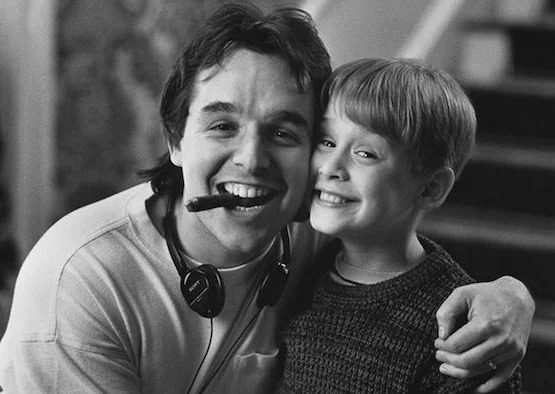
In 1990, Hughes scored the biggest box-office triumph of his career with Home Alone. The holiday blockbuster follows young Kevin McCallister, who is accidentally left behind when his family rushes off to Paris for Christmas. Kevin not only learns to fend for himself for a few days, but he must also defend his home against a pair of bumbling burglars. Home Alone showcased yet another dimension of Hughes’ storytelling: his ability to craft genuine four-quadrant family entertainment. Children embraced the slapstick adventure, while parents saw a tender reflection on family bonds and the quiet terror of losing those you love.
Set once again in the leafy suburbs outside Chicago, the McCallister residence went on to become one of the most famous houses in cinematic history.
Stepping Away from Hollywood
By the mid-1990s, Hughes began quietly pulling back from the Hollywood machine and public life. His final directorial effort was the 1991 comedy-drama Curly Sue; he would never direct another feature film. Leaving Los Angeles behind, Hughes returned to the Chicago area, largely avoiding the press and rarely appearing in the public eye.
On August 6, 2009, Hughes died unexpectedly from a heart attack at the age of 59 while taking a morning walk through Manhattan during a family visit. His sudden passing prompted an outpouring of grief across the industry. To the many actors whose careers he launched, he was far more than a director; he was a mentor who gave them their defining break.
In the twenty-first century, fascination with 1980s culture has reached new heights. Modern pop culture repeatedly draws from that decade, and Hughes’ films remain the definitive touchstone for that retro look and feel. Yet audiences return to his work for reasons that go far deeper than oversized blazers or synthesizer soundtracks: they return for the emotional honesty. Hughes’ characters feel real, even when the world around them belongs to a bygone era. While rooted in a specific place and time, his stories resonate globally because the core human longings are universal. We all want to belong, make friends, fall in love, avoid letting down our parents, and occasionally escape the routine of everyday life. That is why the films of John Hughes continue to speak to every new generation that discovers them.